Stamp Out Democracy

stamp out democracy

Noreen Grahame
Stamp Out Democracy, 2012
Rubber-stamps on Kaskad Wheatear Yellow and Curious Translucent paper.
Machine bound with red cotton.
21.0 x 15.0 cm.
Signed and numbered.
Edition of 100.

Usados para endossar documentos oficiais, os humildes carimbos encarnam o poder. Por essa razão apenas foram empregados para fazer o livro Stamp out Democracy.
Um número mínimo de palavras ‘endossam’ a mensagem de que a democracia é sempre vulnerável. Como todos os perigos que começam pequenos e são ignorados, ‘stamp out‘ cresce em força a cada página até que ‘democracy‘ seja ‘erradicada’.

stamp our democracy centre page

Used for official endorsements the humble rubber-stamp embodies power. For just that reason rubber-stamps are employed in Stamp out Democracy.

A minimum number of words ‘endorse’ the message that democracy is always vulnerable. Like all dangers that begin small and are ignored ‘stamp out’ grows in strength with each page until ‘democracy’ has been ‘stamped out’.
On the surface a light-hearted book commenting on the erosion of democratic rights. Below the surface, page by page, this light-heartedness is stamped out.

http://www.grahamegalleries.com.au/index.php/stamp-out-democracy

MzLk

E3P1-17

Brad Freeman
MuzeLink: The Tours
Purchase, New York: JAB Books, 1997
Offset
168 p.
11” x 8 1/2”
100 ex.

Processos  tradicionais e alternativos de pré-impressão, bem como imagens geradas por computador com base em fotografias, impresso em offset por Brad Freeman em cerca de dez cores. Duotones, tritones e separações de cores por toda parte. Costurado e encadernado pelo artista em uma edição de 100 exemplares.

Traditional and alternative graphic arts darkroom pre-press as well as computer generated photo based imagery offset printed by BF on LOE dull coated 100 lb. text, in around ten colors. Duotones, tritones and four color separations throughout. Case bound and hand sewn by the artist in an edition of 100.

MuzeLink é uma história pessoal da impressão, começando com uma desconstrução lúdica do processo de impressão offset, em seguida, associando quatro reproduções a cores de cromolitografias do século 19 (o progenitor de litografia offset). Estas imagens fornecem uma visão sucinta dos valores sociais da época e lugar. Este é um livro complexo, que ressoa para trás e para a frente, fazendo referência ao livro como conceito e forma histórica, e o livro como meio para um artista.

MuzeLink is a personal / printing history starting with a playful deconstruction of the offset printing process then linking to four color reproductions of 19th century chromolithographs (the progenitor of offset lithography). These images provide a succinct view of the social values of that time and place. This is a complex book which resonates backward and forward, referencing the book as concept and historical form, and the book as an artist’s medium.

Nancy Princenthal escreve sobre MuzeLink:

“. . . não há nada esquemático sobre este livro. Apresentado com capas originais, feita de colagens a partir de folhas de ajuste com o título em prata e encadernado em seda Asahi, a festa visual de Freeman pode ser experienciada tão livremente como qualquer hipertexto. É servida, no entanto, com a compostura de alguém que conhece a sua história e vai satisfazer até quem lê-lo do início ao fim.
(From”On Paper”, novembro-dezembro 1997).

Nancy Princenthal writes of MuzeLink , “ . . . there is nothing schematic about this book. Presented in unique covers collaged from set-up sheets titled in silver, and bound in Asahi silk, Freeman’s visual feast can be sampled as freely as any hot-linked hypertext. It is served, however, with the composure of someone who knows his story will satisfy even those who read it from front to back.”
(From “On Paper”, Nov. – Dec. 1997)

(via http://www.bradfreemanbooks.com/)

Pré-História: Uma leitura projetada

Wlademir Dias Pino_Pré-história, uma Leitura ProjetadaPré-História: Uma leitura projetada
(Coleção Enciclopédia Visual, volume 256)
Leitura gráfica de Wlademir Dias Pino

Rio de Janeiro: Europa, 1991
21,5 x 21,5
36 fls

Um dos 1.001 volumes da Enciclopédia Visual criada por Wlademir Dias-Pino no início da década de 1970. Cada volume é um portfolio com 36 lâminas, com impressão a cores especiais.

dias-pino_img391.jpg

dias-pino_img392

OEI Magazine

OEI_66

OEI – nº 66
520 pag
OEI Editör (27 Sept. 2014)
Language: English
ISBN-10: 9185905690
ISBN-13: 978-9185905690
19,5 x 3,6 x 29,7 cm

A biblioteca recebeu um exemplar da revista sueca OEI, edição dedicada ao poema-processo. A edição é incrível, com imagens de boa qualidade de obras seminais de Alvaro de Sá, Neide de Sá, Falves Silva e Moacy Cirne.

Tem entrevista com os membros fundadores do movimento e a reprodução completa do livro “A Ave”, de Wlademir Dias-Pino, obra que é considerada pelo Ulises Carrión um dos primeiros exemplos de livro de artista. Aguardamos a publicação de algo semelhante no Brasil.

Algumas obras reproduzidas na revista fazem parte do acervo da Coleção Livro de Artista da UFMG.

OEI # 66: Process/poem (poema/processo)
OEI # 66 is the first substantial presentation outside of Brazil of the avant-garde movement poema/processo (process/poem), launched at the same time, on December 11 1967, in Rio de Janeiro and Natal. Due to pressure from the military dictatorship the movement was brought to a halt in 1972, but several of the initial participants have continued to work up until today (Wlademir Dias-Pino, Neide de Sá, Falves Silva…).

OEI # 66 is a 520 pages long montage of images and documents, translations of manifestos and key essays, and interviews and new essays by Fernanda Nogueira, Antonio Sergio Bessa and many others. It also features shorter presentations of three other Brazilian avant-garde movements from the 60s, 70s and early 80s: poesia práxis, poesia marginal and pornismo.

OEI # 66 is edited by Jonas (J) Magnusson, Cecilia Grönberg and Tobi Maier.

Content: Introduction // Proposition // Process – reading of the project // Halt – tactic option // Limit situation: distinctions & consequences // Process /poem // Reading / writing // Poem out of process / 1 // Process /poem: reading of products (of positions ), Wlademir Dias-Pino // Ponto 1 // [Presentation of Brasil meia-meia], Wlademir Dias-Pino // The system and the revolutionary openings, Moacy Cirne // The time of the poem, Álvaro de Sá // O Sol // Ponto 2 // Two or three things about poema/processo, Moacy Cirne Poema/processo. // Poetic radicality and dissent, Fernanda Nogueira // The avant-garde beyond the Avant-garde – The case of poema/processo in Brazil, Fernanda Nogueira // Intensified reading, expanded writing (a conversation with Wlademir Dias-Pino on intensivism, concrete poetry, process/poem and the visual encyclopedia) // A AVE (1956), Wlademir Dias-Pino // Processo 1 // Vírgula // Poema/processo: a new reading, Álvaro de Sá // The origin of the book-poem, Álvaro de Sá & Moacy Cirne // The poem and the electronic opening, Álvaro de Sá // Avant-garde: a semiological project, Moacy Cirne // Writing and information (on Wlademir Dias-Pino’s book-poems), Priscilla Guimarães Martins // Pages from A AVE (estudo crítico), Wlademir Dias-Pino // Pages from SOLIDA (critical study), Wlademir Dias-Pino // A AVE and SOLIDA by Wlademir Dias-Pino. The poetic semiotics as tactile and tactic device, Fernanda Nogueira // A Marca e o Logotipo Brasileiros, Wlademir Dias-Pino & João Felício dos Santos // Pré-História: uma leitura projetada, Wlademir Dias-Pino // Enciclopédia Visual, Wlademir Dias-Pino // Wlademir Dias-Pino’s white encyclopedia, Rogerio Camara // Unfolding processes (an interview with Neide de Sá) // Founding proposals of poema /processo, Neide de Sá // Neide Sá’s process/poems, Eduardo Kac // Poema/processo & comics, Moacy Cirne // 12 x 9 (1967), Álvaro de Sá // The War of Words, Antonio Sergio Bessa // Theory of guerrilla art, Décio Pignatari // New language, new poetry, Luis Ângelo Pinto & Décio Pignatari // New poetry, new process: 8 points // Não ao não (1969/1970), Dalor Varela // Falves Silva – the transgressive eye, Jota Medeiros // The creative explovision of the process/poem, Falves Silva // Poema/processo in the Northeast (an interview with Falves Silva by Cristina Freire) // A Falves Silva poem, Dácio Galvão // Elementos da Semiótica, Falves Silva // New Latin-American Poetry (an interview with Clemente Padín by Cristina Freire) // How I connected with poema/processo?, Clemente Padín // The reading as an object of the eye, Almandrade // Working outside of the circuit (an interview with Almandrade) // BR.– Meia Meia– W. Dias-Pino, Almandrade // Brief synopsis of poema/processo, Álvaro de Sá // Poema-práxis (didactical manifesto), Mário Chamie // Poesia Marginal, Sergio Cohn // Intersemiotic poetry and experimental magazines (an interview with Omar Khouri) // Criticality and vertigo (an interview with Régis Bonvicino) // Middle Class & Co and other works, Regina Silveira // In the Mail Art Circuit, Regina Silveira // Making love to a Xerox machine (an interview with Hudinilson Jr.) // The Porn Art Movement: A Brazilian Avant-Garde, 1980–1982, Eduardo Kac

http://www.oei.nu/w/3.html

A Lisa Escolha do Carinho

Wlademir Dias Pino_Lisa escolha do carinhoA Lisa Escolha do Carinho.
(Coleção Enciclopédia Visual, volume 62)
poemas de Vinícius de Moraes, Manuel Bandeira e outros poetas, acompanhados de desenhos de mulheres feitos com nanquim.
Leitura gráfica de Wlademir Dias Pino

Rio de Janeiro: Europa, 1991
21,5 x 21,5
36 fls

Um dos 1.001 volumes da Enciclopédia Visual criada por Wlademir Dias-Pino no início da década de 1970. Cada volume é um portfolio com 36 lâminas, com impressão a cores especiais.

dias-pino_img395

dias-pino_img396.jpg

Notebooks

10733w

George Brecht
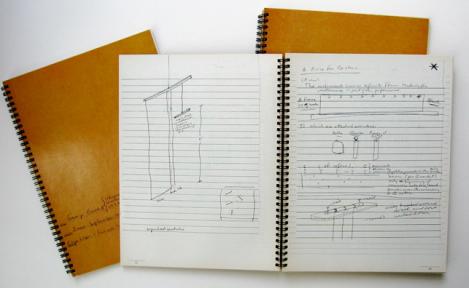
Notebooks. Volumes I – III.
Verlag der Buchhandlung, Walter Konig, Cologne, 1991.
23 x 31 cm.
Editado por D. Daniels com a colaboração de Hermann Braun.
Cada volume com inúmeras figuras e fac-símiles de esboços.
Encadernação em espiral.

Volume 1: Maio – Setembro 1958 (104 p.)
Volume 2: Outubro 1958 – Abril 1959 (166 p.)
Volume 3: Abril – Setembro 1959.

O editor Walther König publicou em 1991 os três primeiros volumes da edição das notas manuscritas, cartas, desenhos, instruções de projetos, esboços de composição e partituras. A edição oferece uma visão diferenciada e genuína dos primeiros dias do Fluxus e o surgimento dos happenings.

George Brecht (1926- 2008) foi um dos primeiros artistas Fluxus. Em 1958-1959 estudou com John Cage em Nova York e participou das primeiras ações do Fluxus. Em 1965 ele se mudou para a França, em 1970 foi para Dusseldorf e em seguida para Colônia, na Alemanha. Além de objetos de arte, realizou também filmes, livros e composições. Participou da Documenta 5, 6 (1977) e 8 (1987), trabalhou em conjunto com John Cage, Dick Higgins, Patrick Hughes e Robert Filliou.

AB_Brecht Georges_Notebooks I II III_Interior 1

imagem: http://artistsbooksandmultiples.blogspot.com.br/

Four percent of Moby Dick

moby-dick

Herman Melville [Michael Maranda]
Four Percent of Moby Dick
Toronto: Parasitic Ventures Press, 2006
284 p.
22,7 x 15,2 cm
ISBN 0-9697368-3-5

From the artist:
Herman Melville is unable to comment on this critical edition of his work.

parasiticventurespress.com

Disponível em PDF

Referência:
Gilbert, Annette (ed.). Reprint: Appropriation (&) Literature. Weisbaden: Lux Books, 2014, p. 271.