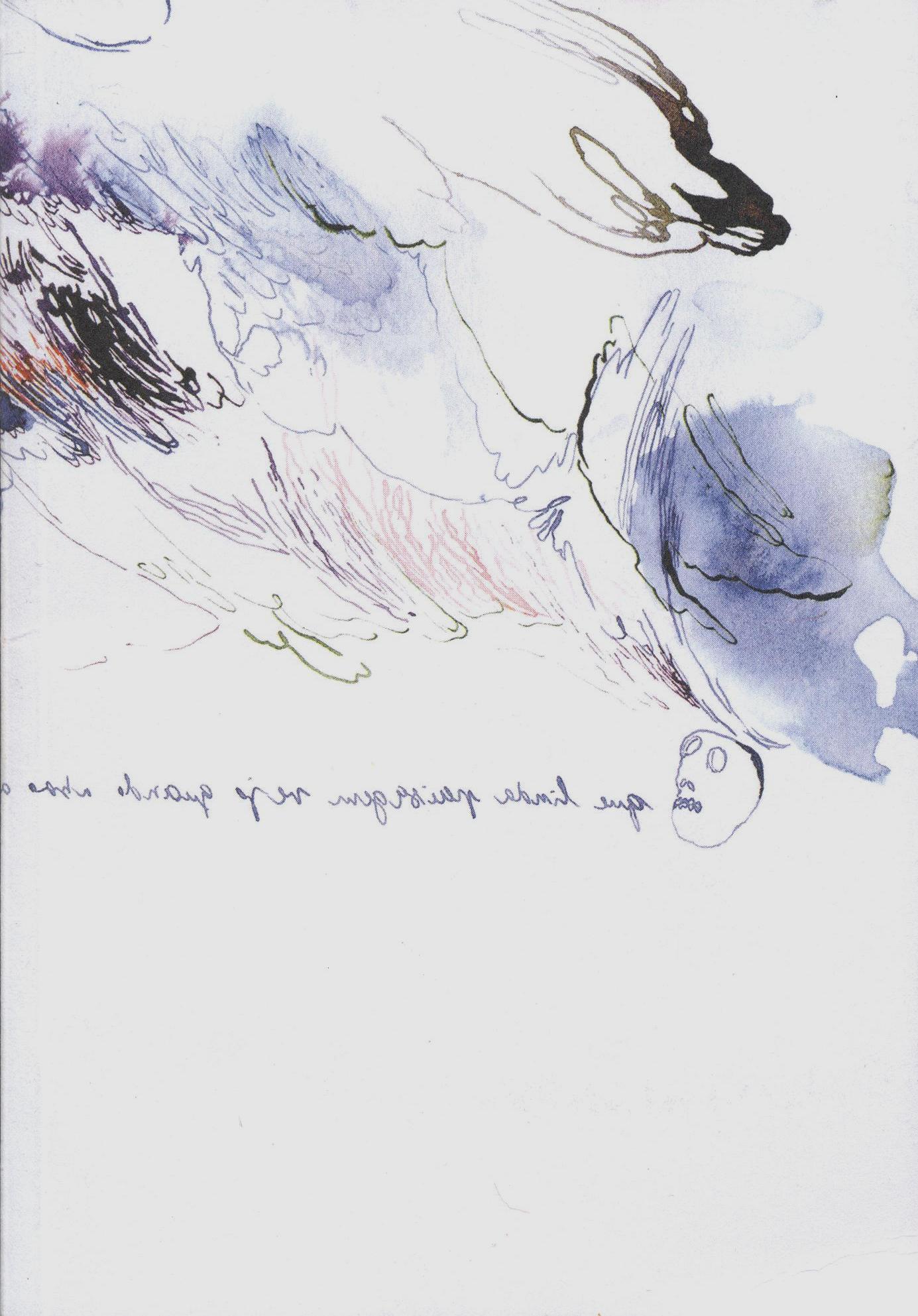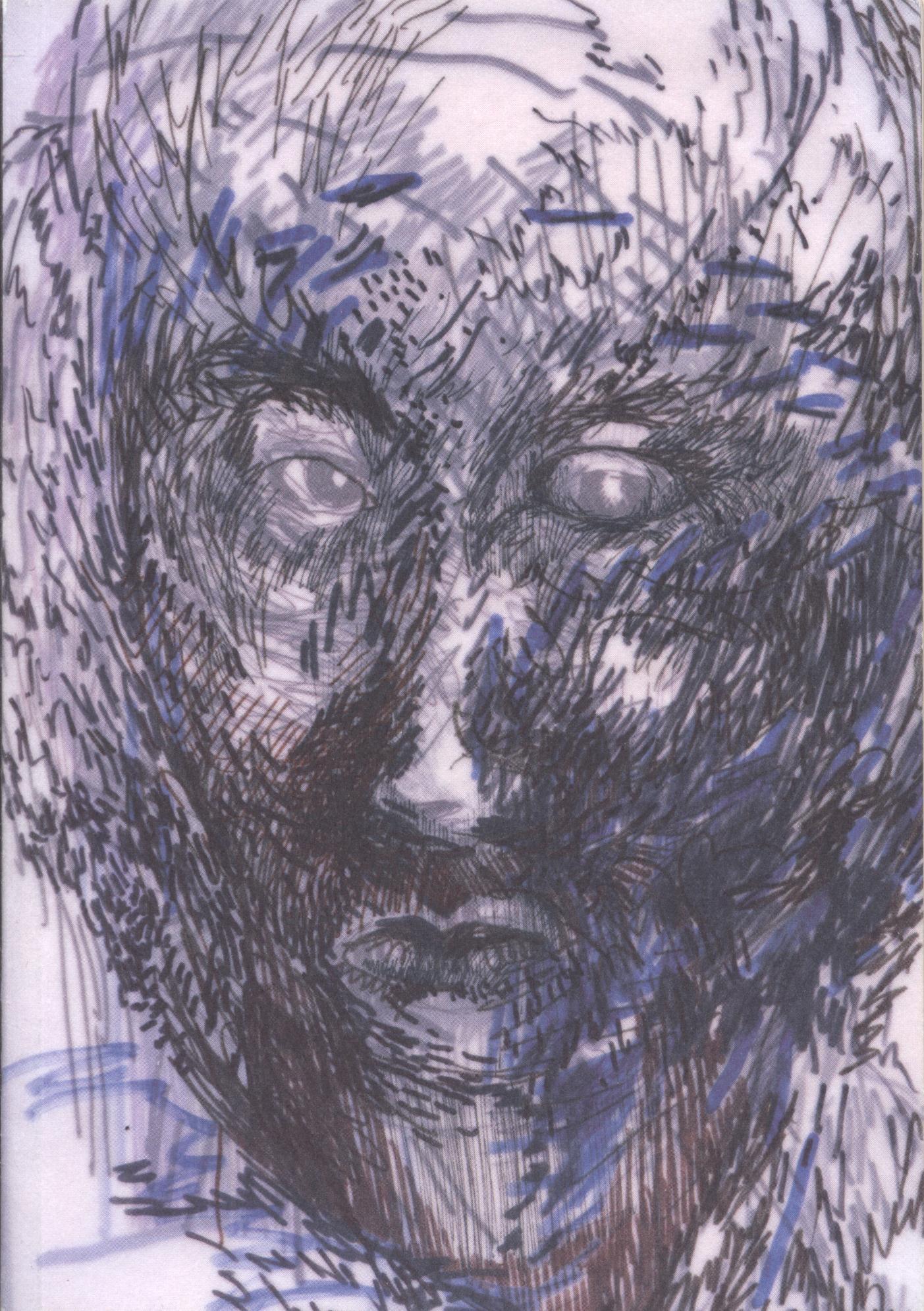
Zine Parasita nº10

E1P5-19

Adriana Hiromoto, Guilherme Falcão
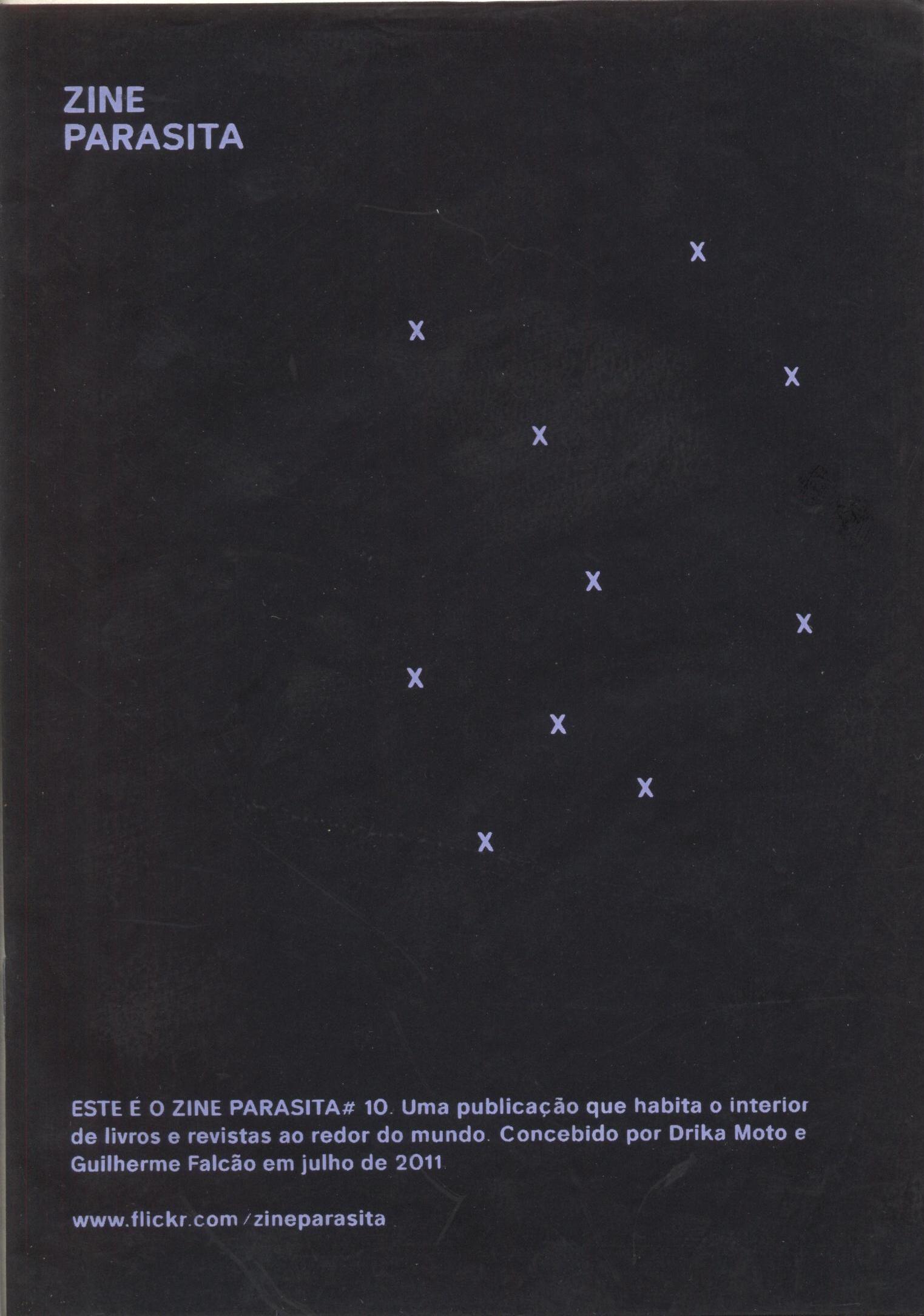
Zine Parasita # 10 / concebido por Drika Moto e Guilherme Falcão.
[São Paulo: Ed. do Autor], 2011.

[16] p.; 18 x 13 cm.
Serigrafia sobre papel carbono preto.
Fólios grampeados.

Edição especial para a exposição “Além da Biblioteca” no Museu Lasar Segall, em agosto de 2011.

https://www.facebook.com/zineparasita

“Esta publicação habita o interior de livros, revistas e outros tipos de publicação ao redor do mundo”.

Zine Parasita nº9

E1P5-18

Guilherme Falcão
Zine parasita 9 = Parasite zine 9 / tema, seleção e design Guilherme Falcão.
[São Paulo: Ed. do Autor], 2011.

[16] p.: il. p&b; 18 x 13 cm.
Impressão em offset, capa em papel colorido (vermelho).
Texto em português e inglês.
Fólios grampeados.

Colaboradores: Pedro Moraes, Fabio Morais, Lucas Simões, Vitor Cesar, Ana Dias Batista, Adriana Hiromoto, João Doria e Ana Luiza Fonseca.

https://www.facebook.com/zineparasita

“Esta publicação habita o interior de livros, revistas e outros tipos de publicação ao redor do mundo”.

Livro negro

E1P3-09

Isabel Baraona, [Livro negro] = [Black book]
[S.l. : Ed. da Autora], 2009.
[56] p. : il. color.
17 x 12 x 0,5 cm.

Impressão em offset, tiragem: 250 exemplares em papel printset.
Título principal retirado do site da autora.
Brochura com costura.

Site da artista: http://www.isabelbaraona.com/

The book begins and ends with a series of semi-opaque fragments of the image of one or more faces. The printed images are the result of several drawings on numerous layers of tracing paper, which were then superimposed on a de-matching (slightly displaced) way, and therefore fail to form a “complete” and recognizable face. We identify the drawing of a face by deciphering the markings and the places of eyes, nose and mouth – but it is neither a portrait, nor a self-portrait. It is a palimpsest-face: androgynous, without skin or organs, without bones or skull; the drawing suggests only features that change on the next page. It’s the potential drawing of a face, and also its rapid and successive metamorphosis. Each of these drawings and their sequence could be the annotation of a cloud, swirling water or other vegetal or organic material that, for a second, would acquire the configuration of a face.
The core of the story consists of a set of drawings that include narrative scenes and black pages with excerpts of sentences. The narrative scenes are characterized by dense groups of characters gathered around a game that, depending on the pages, is more or less violent, or sometimes watching a strange medical exam. In the black pages filled with liquid stains emerge incomplete sentences with inconclusive content such as “afterwards something remains”(originally written in English) and “stay here, always hesitate”.
The sentence “afterwards something remains” doesn’t have a univocal sense; it implies that there is a “before” and an “after” (somehow marked on the body or in memory). Nor do we know which event has generated the fracture of time. But we know that it contains three possibilities: a continuity (it still is); or it produces something recent/new that is (that still is); or that this is something that already exists and is a leftover or surplus. The word “remains” can be read as a verb or a noun, acquiring two different meanings: “it still is” or “remnants”. Despite these unknowns, we can easily relate this proposition with the repetition of drawings, in particular with the sequences that punctuate the beginning and end of the book (which we named “palimpsest-face”).
In a strict formal sense, this book has no cover. In The Black Book the front cover opens the first series of drawings (which may be termed a first chapter), and the back cover closes the last series of drawings (or the last chapter).

The Black book is sold-out.


(Texto fornecido pela artista ao site Tipo.PT, disponível em: <http://www.tipo.pt/index.php/en/archives/details/8/4>, acesso em 21 out 2015)
O livro azul

E1P3-08

Isabel Barona, [O livro azul]
[S.l. : Ed. do Autor], 2009.
[56] p. : il. color. ;
17 x 12 x 0,5 cm.

Impressão em offset
tiragem: 250 exemplares em papel printset.

The cover of Blue Book repeats a matrix drawing, which represents the primal scene and contains the key to the meaning of the story. In this case the front and back covers are already the story – they’re simultaneously the prelude and the epilogue (apparently the story is always resetting itself).
This matrix drawing is reprinted three times in a given stage, later re-worked and amended (the background colour and number of characters), and reprinted again. Repetition of this specific image is intended to emphasize a narrative constructed as a closed circle, as if the support was a palimpsest that reproduced, after some time of use, the first image drawn on it. Unlike the Book of Sand by Jorge Luis Borges, we always come back to these pages.
In the first matrix drawing (cover) and following pages we read a kind of dialogue: “what a beautiful landscape I see when you open my mouth” overlapped with “it’s another one that opens the mouth and dies “. On pages 8-9 we read “subir l’amour par un trou (undergo love through a hole)” – a phrase of undeniable violence, especially due to its highly sexual ambivalence. In fact, for the impassioned lover, love is pure pathos and he suffers (or endures) love through and in all the orifices of the body: the eyes that want the physical presence of the other, the mouth that utters the words of seduction and enjoys the skin it loves, the ears that pick up everything that moves or hurts, nostrils and all the pores of the body. The body of the one who loves is, all of it, an empty hole ready to be filled by the presence of the beloved.
Despite several text fragments more or less complete and legible, it is impossible to formulate a systematic relationship between the various phrases or draw a consistent conclusion about their meaning, particularly with regard to the assertiveness of “there are neither more nor less, you are not”. In this volume, as in the previous ones, on the one hand there is a strong presence of a drawn text, but on the other hand its content is limited to a minimum and its meaning is ambivalent.
The organization of the pages provides the pretext to show a questioning about the end and the beginning of the book and its narrative coherence. This challenge is explicit in the insertion of the words “the end” on pages 4-5 and the five apparently empty pages that punctuate the book. This image of a screen on a black background that reads “the end” makes the beginning of the book to be seen as its end and allows it to be browsed from back to front.

(Texto fornecido pela artista ao site Tipo.PT, disponível em: <http://www.tipo.pt/index.php/en/archives/details/8/3>, acesso em 21 out 2015)

Site da artista: http://www.isabelbaraona.com/

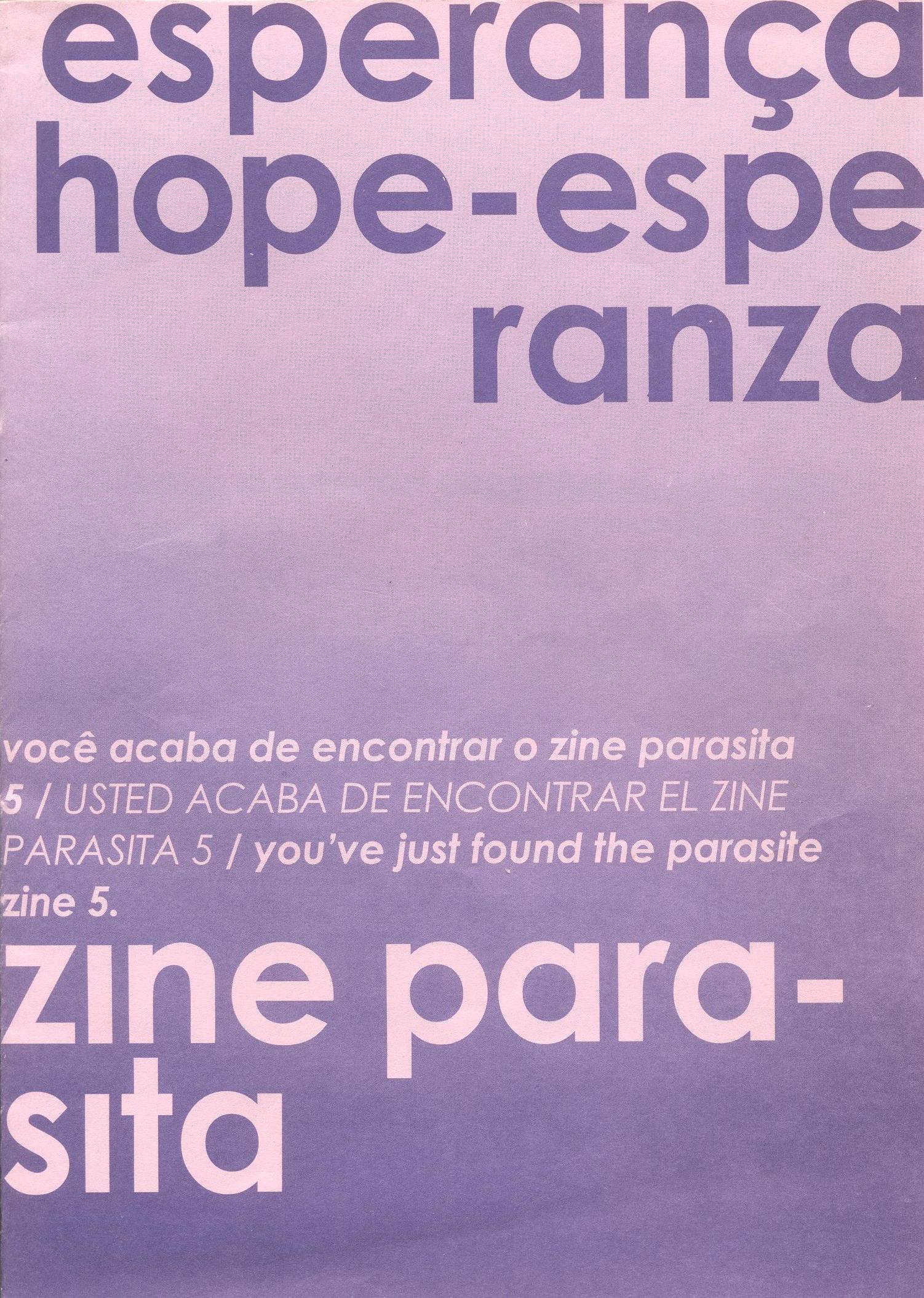
Zine Parasita nº5

E1P5-16

Guilherme Falcão, Adriana Hiromoto, Marco Antonio Silva
Zine parasita 5: Esperança = hope = esperanza
projeto de: Guilherme Falcão, Drika Moto e Marco Silva.
[São Paulo]: Plano B, [2008?].

[12] p.: il.; 18 x 13 cm.
Impressão offset em papel record 75 g/m2 colorido (rosa).
Texto em português, inglês e espanhol.
Fólios grampeados

Participantes: Beto Shibata, Apo Fousek, Madi Ju, Jordi Ferrero, Jessica Williams, Carlos Messias, Nicolas Mastracchio e Felipe Gasparini.

https://www.facebook.com/zineparasita

“Esta publicação habita o interior de livros, revistas e outros tipos de publicação ao redor do mundo” .

Zine Parasita nº3

E1P5-14

Guilherme Falcão, Adriana Hiromoto, Marco Antonio Silva
Zine parasita #03: Animais = Animals = Animales
projeto de: Guilherme Falcão, Drika Moto e Marco Silva.
[São Paulo]: Plano B, [2008].

[12] p.: il. p&b; 18 x 13 cm.
Impresso a laser na cor preta sobre papel verde 90 g/m2.
Texto em português, inglês e espanhol.
Fólios grampeados.

Participantes: Bruno de La Bandeira Martins, Mariana Abasolo, Rui Souza, Videogramo, Paul Hanger, ps.2 arquitetura + design, Ana Helena Tokutake, Davi de Oliveira Pinheiro, Marco Antonio Silva e Mario Ladeira.

https://www.facebook.com/zineparasita

“Esta publicação habita o interior de livros, revistas e outros tipos de publicação ao redor do mundo”.

Zine Parasita nº2

E1P5-13

Guilherme Falcão, Marco Antonio Silva, Ana Helena Tokutake, Adriana Hiromoto
Zine Parasita nº2: Sobre a “juventude”…
projeto de: Guilherme Falcão, Drika Moto e Marco Silva.
[São Paulo]: Plano B, 2007.

[12] p.: il.; 18 x 13 cm.
Impressão a laser em papel record 75 g/m2 colorido (amarelo).
Grampeado.

Participaram desta edição: Ana Helena Tokutake, Davi de Oliveira Pinheiro, Maurício Adachi, Yan Sorgi, Guilherme Falcão, Yan Gomes e Lucas Rampazzo.

“Esta publicação habita o interior de livros, revistas e outros tipos de publicação ao redor do mundo”.

https://www.facebook.com/zineparasita

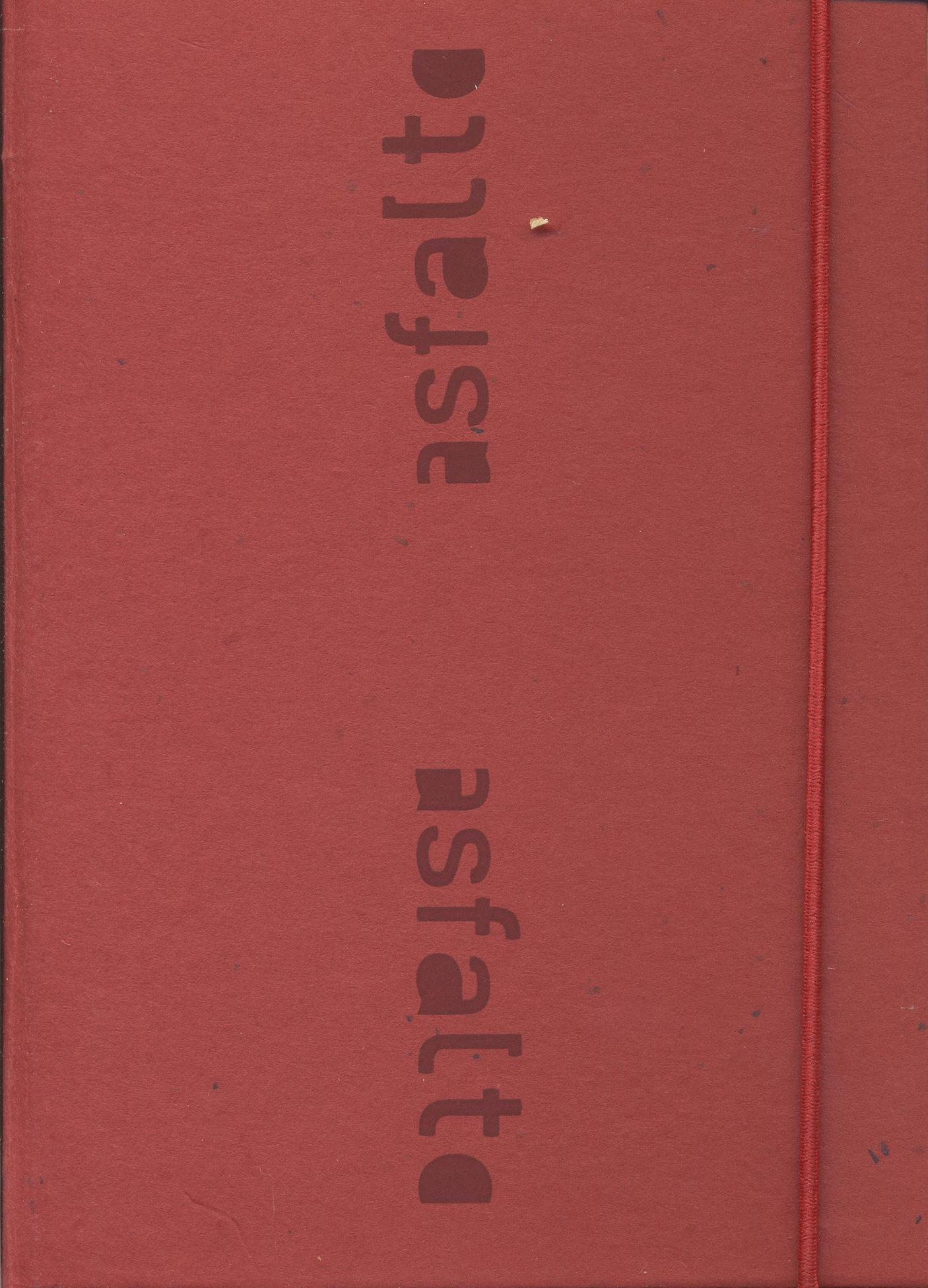
Asfalto

E1P3-06 ASFALTO

Asfalto / Coordenação geral: Fernanda Grigolin ; Coordenação editorial: Carla di Cologna … [et al.] ; Projeto gráfico: Karina Francis Urban ; Apresentação: Adrienne Myrtes.
São José dos Campos (SP) : Publicações Iara, 2011.
12 postais : fots. color. ; em caixa 17 x 12 x 2,5 cm.
Impressão em offset, papel sun 52 warm white smooth 176 gr.
Tiragem: 100 exemplares.
Fotografias de Fernanda Grigolin, Francisco Costa Lima, Leandro Souza, Pedro Nobrega e Sofia GB ; Poemas de Daniel Minchoni, Elizandra Souza, Pedro Tostes, Rafael Avila Matede e Sinhá.
Postais envoltos em fita (0.5cm) de cetim preta .

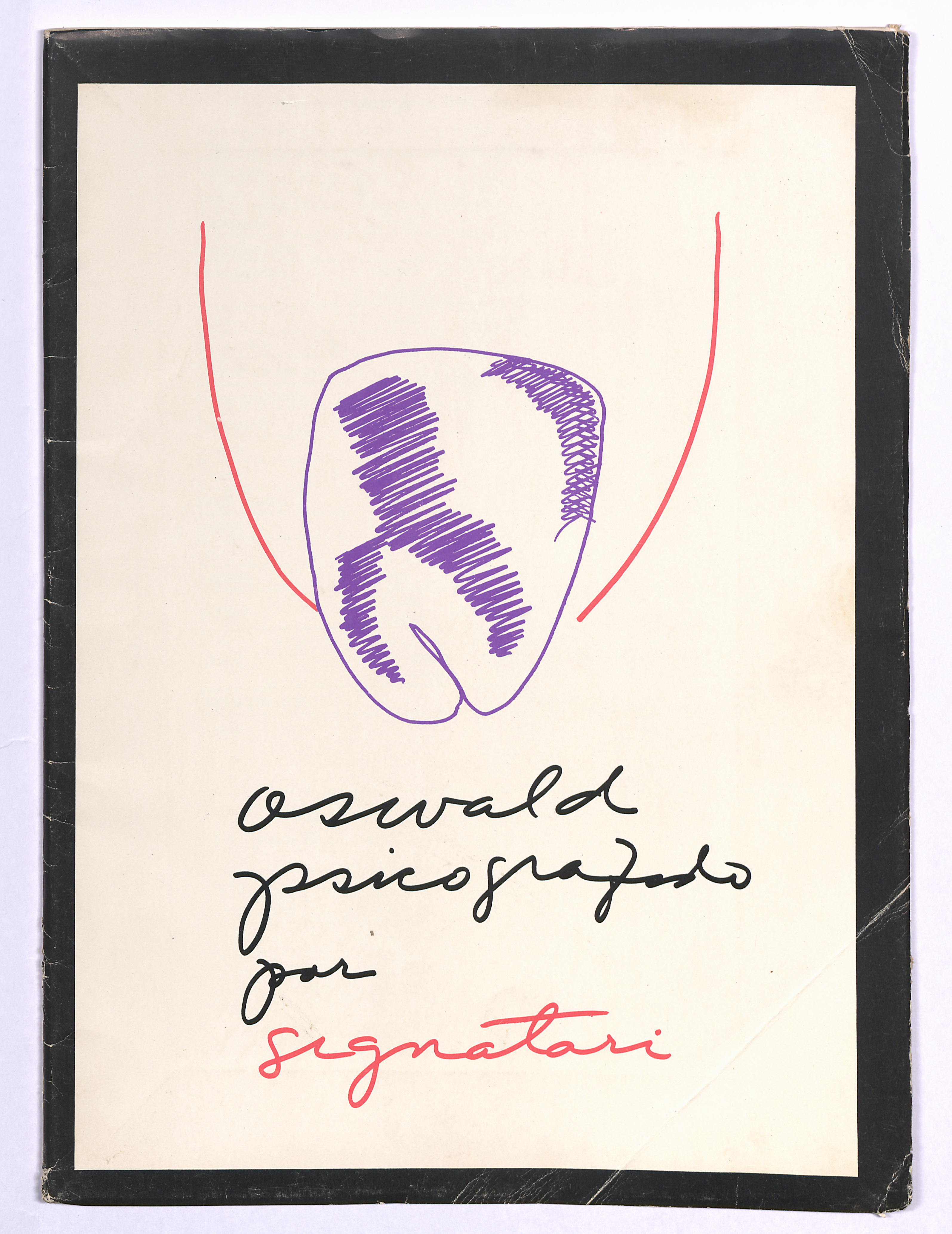
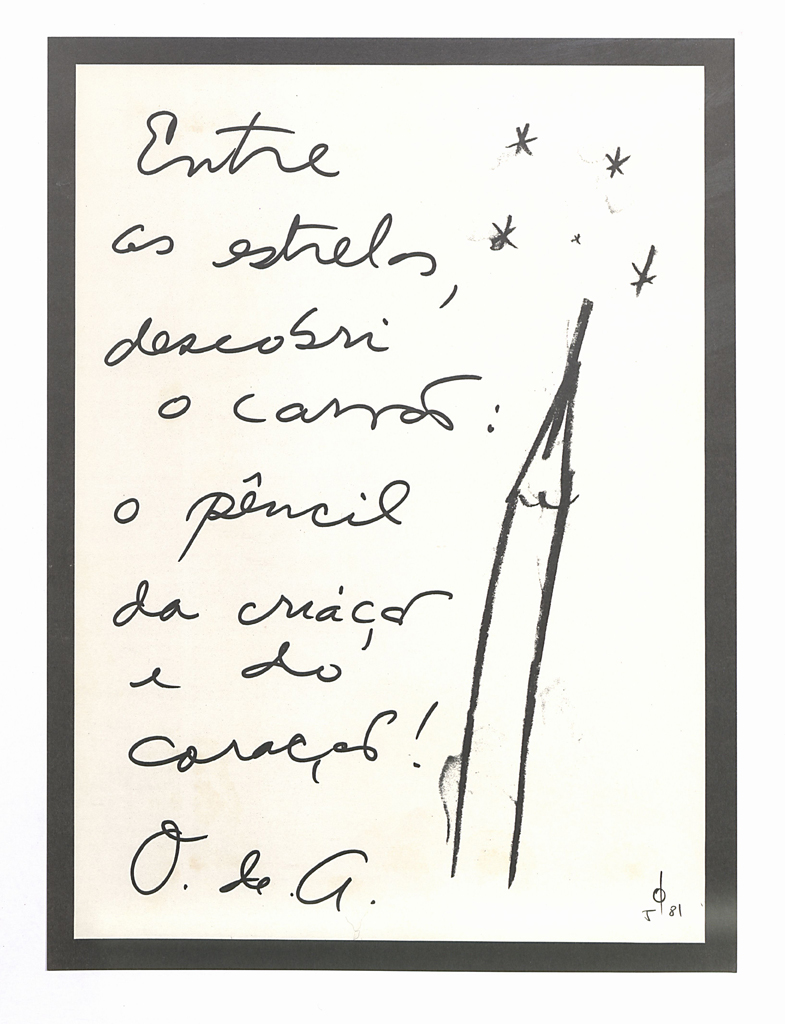
Oswald psicografado por Pignatari

Decio Pignatari_Oswald psicografado

Décio Pignatari (Jundiaí/ SP, 1927-2012 )
Oswald psicografado por Signatari
Salvador/BA: Código, 1981
Erthos Albino de Souza (editor)
24 x 33 cm
número especial da revista Código, 16 pranchas pb e 1 prancha colorida
1.000 ex

Título: “Oswald psicografado por Signatari”: 1 – Você que finalmente 2 – Entre as estrelas 3 – Fusain 4 – Et vous 5 – Encontrei com o Maiá 6 – Seurat, tristinho 7 – No Ágapeda Sincronia 8 – Oh, Catulo! 9 – Num céu picego 10 – Sou um rato vivo 11 – Star 12 – Meu nome diz 13 – As delícias da carne 14 – Pau vs. Pau-Brasil 15 – O Capitalismo caput 16 – Capitalismã 17 – Finalmente

(copiado de http://acervoharoldodecampos.phlnet.com.br/cgi-bin/wxis.exe?IsisScript=phl81.xis&cipar=phl81.cip&lang=por)

Image00055

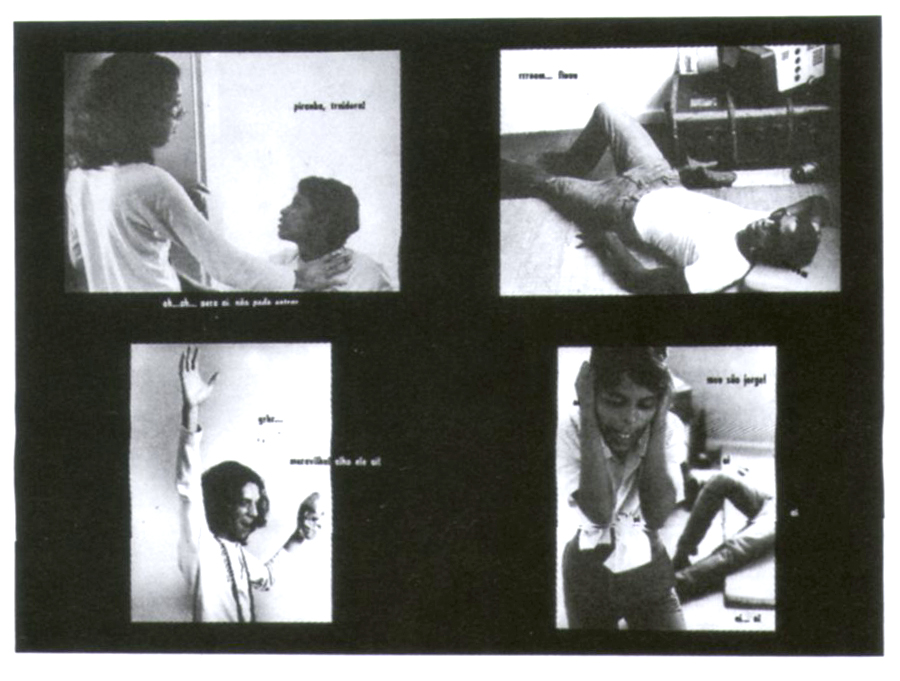
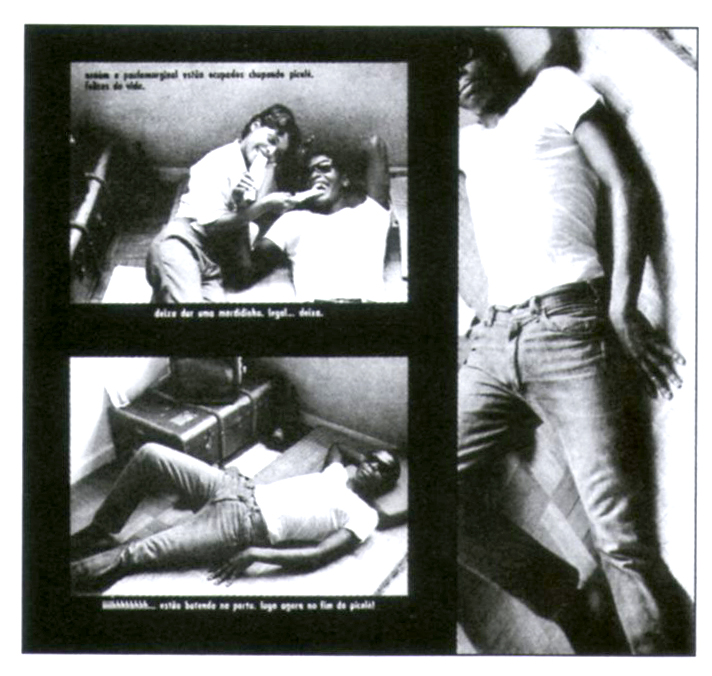
A arma fálica

img893

Antonio Manuel
A arma fálica
Rio de Janeiro, RioArte, 1995

Ficha técnica:
Criação e realização: Antonio Manuel
Fotografia: Kiko
Diálogos: Antonio Manuel, com colaboração de Lygia Pape
Projeto gráfico: Luciano Figueiredo

img892

E apresentando

Hélio Oiticica: guru
Tineca: neném
Paulo: paulomarginal

img891

Trabalho realizado em 1970, publicado em 1995.