Porquoi o mal?

E1P5-07

Jorgen Michaelsen, Porquoi o mal? [Outro título: Pourquoi malady?]
coordenação editorial: Regina Melim
projeto gráfico: Vitor Cesar
tradução: Bia artero
revisão: Renato Tapado.
Florianópolis, SC: Par(ent)esis, 2011.
81 p.;
19 x 14,5 x 0,7 cm.
Impressão offset
tiragem 1.000 exemplares.
Edição bilingue português e inglês.

Edição realizada especificamente para a exposição “El mal de escritura: un proyecto sobre texto e imaginación especulativa”, curadoria de Chus Martínez, no período de 20 de novembro de 2009 a 25 de abril de 2010, no espaço térreo do Centro de Estudos e Documentação do Museu de Arte Contemporânea de Barcelona (Macba).

Em qualquer encontro, quer democrático, quer pseudodemocrático, há duas lacunas que se reforçam mutuamente: uma entre a esfera da transcrição relativa e a emocionalização absoluta do discurso, e outra entre a capacidade excessiva e a convergência paralela. Para se ter certeza, a prática artística pode às vezes aliviar os obstáculos produzidos quando uma metamorfose evidente é fortemente registrada naquilo que parecem ser os disparates do dia-a-dia. Mas a própria obediência civil da representação nunca morre. Não importa quão pavorosa a situação pode se tornar, os agentes culturais emboscados nas asas sempre estarão preparados para atirá-las em seus pés – a um preço. E, finalmente, não é preciso dizer que ninguém é inocente. Por exemplo, você pode marchar sob a bandeira da ‘escrita’ ou do ‘texto’, e de uma maneira ou de outra manter-se completamente preso à estrutura da ‘linguagem’.

[Fragmento da parte inicial]

Robin Redbreast’s Territory

dibbets_12942%5B1%5D

Jan Dibbets
Robin Redbreast’s Territory
Zédélé, 2013
1ª edição: Seth Siegelaub, New York e Walther König, Köln, 1970
12,1 x 18,3 cm
32 p.
Brochura
ISBN 978-2-915859-45-4

Texto in holandês, inglês, francês e alemão

dibbets_getimage

O livro Roodborst Territorium/ScuIptur (1969) de Jan Dibbets, é um documento fotográfico e projetual sobre um trabalho que não é possível ser visto na sua totalidade e que não pode ser recomposto senão através de documentos. A ideia de Dibbets, que consiste em fazer depender sua “escultura” de um pássaro em voo, não é possível senão através de imagens que possibilitam sua existência sensível e acreditável, existência que consiste na variação de forma de uma região a partir da ideia da captura e delimitação das fronteiras espaciais, fronteiras estas delimitadas e indicadas por 5 estacas de madeira onde descansa o pássaro entre os voos. A delimitação destas fronteiras é relativa porque a noção de território se origina na biologia e na ecologia do sistema ao qual o pássaro pertence. O pássaro, nos seus deslocamentos, voa entre as estacas dos 5 pontos diferentes num parque de Amsterdã, configurando seu território biológico. Se o livro apresenta a elaboração e a execução, dando detalhes sobre o procedimento, o tempo registrado, o trabalho material mesmo não deixa traços a não ser no livro.

Julio Plaza, O livro como forma de arte II, 1986

Robin Redbreast’s Territory  is a book documenting a 1969 installation in an Amsterdam park by Jan Dibbets, who observed and highlighted the movements of a robin through a series of photographs. The book, published in 1970, is Dibbets’ only Artist’s book.

After learning about the habits of robins, Jan Dibbets decided to extend the territory of one robin, setting new boundaries with poles that the bird would perch on; in this way, the robin participated in the artist’s ‘Drawing in Space’.

The book’s left-hand pages feature photographs and topographical surveys, alongside handwritten notes by the artist, which are rendered in three other languages (English, French and German) on the right-hand pages.

After giving up painting in 1967, Jan Dibbets began creating ephemeral installations in nature and taking photographs of them. The act is not an end in itself for the artist: his preoccupation is with preserving the meaning of the work, because ultimately what is important is not the reality of the installation but the idea that inspired it.

Robin Redbreast’s Territory is the 6th book to be published in the Reprint collection curated by Anne Moeglin-Delcroix and Clive Phillpot.

“Early in his development Jan Dibbets used the camera to provide a different, specifically monocular, perspective on the world, literally through his ‘perspective corrections’, but also by other means such as the series of photographic panoramas that led to the Dutch Mountains works.

At the same time he was developing the concept of Robin Redbreast’s Territory / Sculpture which ‘was part of a number of ideas which involved our eco-system, a word which hardly existed at that time’. The book’s text describes how Dibbets obtained an insight into the habits of the common European robin through his reading of a book on the subject, even though he was ‘not interested in biological facts,’ but rather ‘with the frontiers of the visual arts.’

Dibbets’s idea was to harness his new understanding of the habits of the robin to his notion of drawing in space and his desire to visualise ecological systems. However, he ‘realised that there was no way to share it with others’ until ‘the idea of the book came along’ thereby establishing an appropriate means.

He had been working with the gallerist and publisher Seth Siegelaub in 1969: ‘I told Seth about it. He immediately was very enthusiastic and after I delivered him all the material, he took care of everything. I only worked with Seth.’

So it was that this example of the book as artwork came about, whereby understanding of the entirety of the work is only possible by means of the artist’s book.” (Text inserted in the book)

http://www.editions-zedele.net/reprint/robin-rebreasts-territory-sculpture_jan-dibbets.html

The weather

41load-vmal

fonte: amazon

Kenneth Goldsmith
The Weather
Make Now Press, 2005
120 p.
Language: English
ISBN: 978-0974355429

Poetry. “Kenneth Goldsmith is without doubt the leading conceptual poet of this time. His poetry, which draws from Fluxus, Dada, and conceptual art traditions, is clever and self aware. With now classics such as FIDGET, SOLILOQUY, and DAY (all available from SPD), he has made poetry out of the mundane and when reading his work one is forced to reconsider the stakes and the measurements of aesthetic practice. THE WEATHER, a collection of weather reports, is one more test of poetry. And what is most striking about this book is that it aces the test. There is something wonderfully celebratory and shockingly pleasant and stimulatingly interesting about reading day after day of weather gone by”–Juliana Spahr.

Salvar

Sports

Kenneth Goldsmith 1961 EUA
Sports
Make Now Press (July 29, 2008)
Paperback: 120 pages
Language: English
ISBN: 978-0981596211

Poetry. SPORTS, the last of Kenneth Goldsmith’s American trilogy (THE WEATHER, TRAFFIC, and SPORTS), is a complete radio transcription of the longest nine inning Major League Baseball game on record. As with the rest of the trilogy, Goldsmith’s exact parsing of language is used to articulate an unfolding narrative. Nothing is left out: in SPORTS we hear every utterance and stumble of the announcers as well as each ad broadcast during the game. It is said that in a normal two and a half hour baseball game, approximately eight minutes of action occurs; this game–the New York Yankees vs. the Boston Red Sox from August of 2006–lasts nearly five hours, doubling the language, leaving the broadcasters a seeming eternity to fill with a parade of endless statistics and in-booth repartee. As the narrative grinds on and the hours pass, a claustrophobic sense of despair descends upon the booth. “Tomorrow?” asks one broadcaster. “I think we’re all writing opuses for tomorrow.”

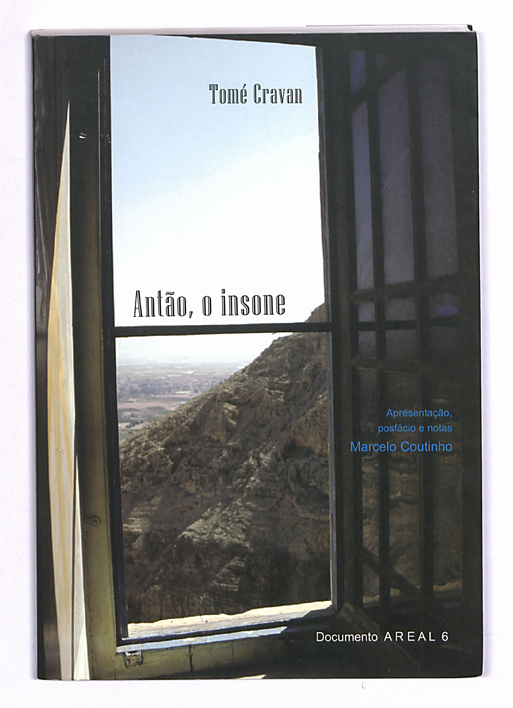
Antão, o insone

Antão insone
Tomé Cravan ( Recife/PE, 1938)
Antão, o insone
Porto Alegre, Zouk, 2008
160 páginas – 16 x 23 cm
ISBN 9788588840751
col. Documento Areal

Publicado originalmente em Portugal apenas em Braille, esta primeira edição brasileira traz a perspicaz e elegante análise de Marcelo Coutinho, estabelecendo um rico diálogo entre obra e crítica. Misto de diário confessional, novela ficcional e ensaio epistemológico sobre as possibilidades de troca entre emissor e receptor. No desenrolar das memórias de Cravan, revelam-se não somente a experiência de convívio que teve entre cegos de nascença, mas, sobretudo, suas indagações sobre a própria cegueira.